











-------------
We also have a Business Card Page. Click here.
----------------

To go to Jim Guild's Famous Brands website, click on the drawing above or here.

Marie and
Kirk in Namibia
Watkins Glen High School teacher Marie Fitzsimmons and her husband, Kirk Peters, have moved on from a Peace Corps posting in China to one in Namibia, on the continent of Africa. They both served as Peace Corps volunteers when they were young adults, too. Marie's report from Namibia follows.
 By
Marie Fitzsimmons
By
Marie Fitzsimmons
It is early morning in Namibia and I have been out to stargaze before light makes her way. Before Kirk came to bed last night, he too sat out among the stars in this barren land. The sky is extraordinary here, and for a couple who is sustained by nature’s beauty, I suspect we will call on the heavens often.
In a way, it feels too soon to write. The feelings and experiences are raw and unprocessed and we have a ways to go before we create a rhythm to our new world. Here we are, our feet walking upon this rough desert earth where there is a harsh beauty in the nothingness of the terrain, of the miles of flat sand-rock with a rise in the distance -- a mesa that seems devoid of human touch. The land is unforgiving, and little grows here.
We live on our school campus, where 90 of the 400 students reside just 200 meters from our cement-block house in the school hostel. Local learners walk home at the day’s end while those who come from afar pay $100 for room and board. That is about $9.00 U.S. While that may seem incredibly cheap, many of our families are living on $400 a year. The hostel is painted bright blue and is kept clean and orderly with eight students to a room. Two teachers stay with the girls and two with the boys so that they may oversee the wellness and behavior of the boarders. The students wash all their clothes by hand and iron their school uniforms every Saturday . They clean the entire hostel -- including the bathrooms -- and are responsible for the school grounds. On Sundays, they go to church. School evenings are reserved for evening study hours, and you can hear a pin drop in the dining hall where they congregate. Some of our students can be rather unruly at school, but never during study hour. Any disruption is taken very seriously.
 We
have hiked kilometers on end to see the village and its surroundings and
while the sun is relentless, we cannot bear to give into her. We walk
through our village of shanty tin huts peppered with brightly painted
homes with plants and scrubs, and greet at least a hundred people. A funeral
procession makes its way to the church, and I can barely hang on to my
manners and keep from photographing the women, so very beautiful in their
traditional garb and sadness.
We
have hiked kilometers on end to see the village and its surroundings and
while the sun is relentless, we cannot bear to give into her. We walk
through our village of shanty tin huts peppered with brightly painted
homes with plants and scrubs, and greet at least a hundred people. A funeral
procession makes its way to the church, and I can barely hang on to my
manners and keep from photographing the women, so very beautiful in their
traditional garb and sadness.
The villagers mostly live in poverty in tin shacks that have been painted an array of colors that somehow withstand the intensity of the sun. Barefoot children play with homemade balls, sticks, and cleverly made go-carts. On Sunday mornings, men and women emerge from their humble homes in stunning perfection to make their way to church, where they will spend most the day praying and singing. The juxtaposition is mind blowing -- starched white shirts and creased slacks for the men and high heels and pressed dresses for the women while a tin shack is their own shelter from the Namibian sun. Those who have jobs with the government are provided with housing and enjoy a higher standard of living in much more comfort. Satellite dishes, vehicles, solar panels and such stand out as a testament to wealth.
To the west, where the Fish River lies, the terrain rises and falls, and there are areas of oases where greenery gladdens the eye and the desert gives way to the momentary relief of moisture. We were excited to hear that our town was near a river, but when we hiked up to the old school grounds on a hill that overlooks all of our community, the dry river bed was a painful testament to this hard life. The villagers tell us that the river will flow when the rains come and the dam in the north is released. The children say that all the school will go to the river on that day and we shall swim and play. Oh, I cannot wait for such a celebration. We hope this drought will not deny the people of our new home respite.
 We
have since hiked miles along the river bed where we are mesmerized by
the rock formations that tell a story millions of years old. Pieces of
a meteorite have been moved to Windhoek, the capital city, for tourists
to admire, but it is our small village where any geologist would be thrilled
to live. Or at least to study. …..We carry a compass and whistle
with us, gifts from the sweet staff at Watkins Glen High School, and sticks
to ward off the baboons. The villagers say the baboons will not bother
us, but wow, their size and agility are intimidating and thrilling. We
were awed on our journey here as we saw giraffe, zebra and ostrich just
150 kilometers from our new home.
We
have since hiked miles along the river bed where we are mesmerized by
the rock formations that tell a story millions of years old. Pieces of
a meteorite have been moved to Windhoek, the capital city, for tourists
to admire, but it is our small village where any geologist would be thrilled
to live. Or at least to study. …..We carry a compass and whistle
with us, gifts from the sweet staff at Watkins Glen High School, and sticks
to ward off the baboons. The villagers say the baboons will not bother
us, but wow, their size and agility are intimidating and thrilling. We
were awed on our journey here as we saw giraffe, zebra and ostrich just
150 kilometers from our new home.
While hiking, we meet one of our students, Samuel, who is herding his family’s goats with his younger brother. They have 76 goats that will roam kilometers throughout the day and then return home to the kraal outside their house. Samuel says he loves going with the goats, for he can see so many things. It’s a funny thing -- the desert seems so vast and empty and then one begins to see…..
We live here in Nama land where Khoekhoegowab is the predominant language, though both Afrikaans and English are spoken by a segment of our local population and at least 24 other distinct languages are spoken throughout the country. The history of Namibia is wrapped in the brutal colonization of the Germans and the devastating impact of the Berlin Conference of 1884. In more current history, it was the apartheid regime of South Africa that held the land and the people hostage. It is written that the Germans used Namibia as a training ground for the Holocaust, honing their devastating practices of ethnic genocide against the Herero and decimating the Damara and Nama who challenged Germany’s right to steal their land. While I have read and taught this history, my knowledge was on an academic level. Now I teach the descendents of Henri Witbooi -- the nation’s Nama hero who rose up against the Germans to defend his people and lost his life in battle in 1907 .The Nama revere him. I have his great great great grandson in my class. His house stands in our village. Wow.
 As
the Germans lost WWI, so went all their colonies in Africa. That brief
notion of freedom was lost when the South African colonial regime took
control of Namibia via The League of Nations Mandate in 1920 and before
long, South Africa extended its apartheid practices to control the rich
minerals ---diamonds, copper, uranium, tungsten, aluminum -- of Namibia.
Despite the later ruling of the United Nations that South Africa must
relinquish control and allow for a free Namibia, it would take decades
of resistance by SWAPO and the crumbling of South Africa’s own apartheid
government for Namibia to claim her independence.
As
the Germans lost WWI, so went all their colonies in Africa. That brief
notion of freedom was lost when the South African colonial regime took
control of Namibia via The League of Nations Mandate in 1920 and before
long, South Africa extended its apartheid practices to control the rich
minerals ---diamonds, copper, uranium, tungsten, aluminum -- of Namibia.
Despite the later ruling of the United Nations that South Africa must
relinquish control and allow for a free Namibia, it would take decades
of resistance by SWAPO and the crumbling of South Africa’s own apartheid
government for Namibia to claim her independence.
In that freedom, the government had to find a way to create unity among the many ethnic groups --the Nama, the Herero, the Oshivango, the Damara, the Tswana, the Germans, the Afrikaners, and so many more. It was decided that the means to creating a cohesive nation depended on a language that crossed every area and cultural boundary. It was too soon for the country to stomach the use of Afrikaans; thus, English became the language of the schools in 1992. (Afrikaans is the Dutch-based language that was associated with oppression. It is now spoken by many Africans and Europeans without the angst of injustice)
How do you take two million people of 25 different languages and ethnic backgrounds and make English the language of the country? How do you hold on to the rich cultures and the languages that have identified each ethnic group for hundreds of years? Every school child is now taught every subject in English except for a course in the language of their mother tongue, assuring the preservation of their heritage. (Still, the elders worry that the children may lose fluency of their mother tongue.) It will take another generation to develop fluency in English, but from our short time here, we are mighty impressed with the effort and believe in this policy that respects the mother tongue while developing a common language for all. We are proud that the Peace Corps is playing such a vital role in contributing to this goal. For each child who attains fluency, the door can open brightly to university acceptance, employment, and economic wellness. Beyond that, we are helping a nation in its path to unity. That feels so good.
 And
so, we are relentless in our classrooms, where we teach students in their
very first year of secondary school -- the eighth graders. Teaching eighth
grade is no easy feat in any circumstance. Thirteen is a heady year in
any society, and creating classroom decorum in classes of 42 in temperatures
of 100 degrees is not for the faint of heart. Kirk has a very heavy load
teaching both Life Science and Physical Science The concepts of the Physical
Science class are so challenging and the resources are so limited. The
literacy of the students varies greatly and for some, this is their biggest
foray into the world of English academia. This week will be the introduction
of atomic structure and the periodic table. Oh, my -- even with English
as a first language, that is a challenging task for kids. Mesh that challenge
with an empty stomach and a gritty and relentless poverty, and it is a
daunting task.
And
so, we are relentless in our classrooms, where we teach students in their
very first year of secondary school -- the eighth graders. Teaching eighth
grade is no easy feat in any circumstance. Thirteen is a heady year in
any society, and creating classroom decorum in classes of 42 in temperatures
of 100 degrees is not for the faint of heart. Kirk has a very heavy load
teaching both Life Science and Physical Science The concepts of the Physical
Science class are so challenging and the resources are so limited. The
literacy of the students varies greatly and for some, this is their biggest
foray into the world of English academia. This week will be the introduction
of atomic structure and the periodic table. Oh, my -- even with English
as a first language, that is a challenging task for kids. Mesh that challenge
with an empty stomach and a gritty and relentless poverty, and it is a
daunting task.
The science club had its first meeting this Saturday and what an outing it was -- 20 students and their intrepid teachers heading off into the desert and coming back with such treasures: insects galore, lizards, a stunning rock collection. The students were so happy. Kirk, too.
I have my classroom set up in six groups of seven with team captains for every group. We just finished our second writing workshop where we have brainstormed, written, edited, re-written, edited, and re-written essays on the pros and cons of English speaking schools in Namibia. I have my cement room decorated with bright colors from our trip to our shopping town, 70 kilometers to the north. The work of my students is proudly hanging throughout the room and everyone comes in to read their essays and poetry. We have established a modicum of order and I am thrilled out of my mind at their progress.
 I
teach all 9th and 10th graders a course known as Basic Information Science
(BIS) and that is great fun for me. The students are thrilled to learn
about all learning resources and I am such a lover of the written word.
We have a ball together and I can see them learning in leaps and bounds.
I am intrigued by the curriculum requirement of computer and internet
use. There are six computers, one outlet in the room, and only the administration
office has internet. Sometimes.
I
teach all 9th and 10th graders a course known as Basic Information Science
(BIS) and that is great fun for me. The students are thrilled to learn
about all learning resources and I am such a lover of the written word.
We have a ball together and I can see them learning in leaps and bounds.
I am intrigued by the curriculum requirement of computer and internet
use. There are six computers, one outlet in the room, and only the administration
office has internet. Sometimes.
I am tasked with opening the school library by tomorrow! The school has not had a library for years, and this is one of the major projects of my volunteerism. I am beyond thrilled to have such an assignment as I know the power of literacy. I have been working for hours on end -- cleaning, registering, sorting and shelving. The students help me all the time and I have learned how to delegate in this mammoth task. I fantasize about our WGHS librarian Maggie Field and assistant, Amy Lakomy, flying over to help me…I am sure that I have made organizational mistakes, but I am over the moon that the students will be able to borrow books. Isn’t that great?
I have been called back to the world of coaching and my 56-year-old legs are back at the world of drills, speed work, and endurance. My coaching partner, Mr. Tjaronda, has taught me new drills while I could not help but introduce British Bulldog, ladder runs, freeze tag and the dreaded whistle runs that my WG athletes may never forgive me for
 As
our students here trained for a regional competition, I vacillated between
wanting shoes on the feet of our athletes and total awe and appreciation
for the toughness it takes to run on the rocky terrain that is littered
with glass. There is nary a word about shoes, though we all weary of the
sun and can falter in her intensity. For a woman who coached for so many
years and attended hundreds of track meets, you can imagine my excitement
when the big day arrived. Without shoes or uniforms on a dirt track in
100-degree weather, we competed for eight hours in the burning sun. When
a cloud cover settled for a short while --oh sweetness. But not as sweet
when Gusmao took 2nd place in the high jump and Enrico won the 1,500 meters
race… Or when Jerome was leading in the 100 meters when his his
bare foot was cut open by a sharp rock on the track and he did not falter.
You would love these kids with their determination, hard work, and good
spirit. Young Christina from the middle school won the U15 1500, and you
can see in her form and power that she will be a force to contend with
for years to come.
As
our students here trained for a regional competition, I vacillated between
wanting shoes on the feet of our athletes and total awe and appreciation
for the toughness it takes to run on the rocky terrain that is littered
with glass. There is nary a word about shoes, though we all weary of the
sun and can falter in her intensity. For a woman who coached for so many
years and attended hundreds of track meets, you can imagine my excitement
when the big day arrived. Without shoes or uniforms on a dirt track in
100-degree weather, we competed for eight hours in the burning sun. When
a cloud cover settled for a short while --oh sweetness. But not as sweet
when Gusmao took 2nd place in the high jump and Enrico won the 1,500 meters
race… Or when Jerome was leading in the 100 meters when his his
bare foot was cut open by a sharp rock on the track and he did not falter.
You would love these kids with their determination, hard work, and good
spirit. Young Christina from the middle school won the U15 1500, and you
can see in her form and power that she will be a force to contend with
for years to come.
 I
think of my students at home and am thrilled that I will get to share
this wondrous experience with them when I return to WGHS in September.
Any time there is internet access, I eagerly read of their feats and celebrate
with them from afar -- so pleased for their academic, social, and athletic
passion. I smile to read of so many sports victories and am so impressed
by the our teams. We send our love to all of our community, with particular
gratitude for the stalwart protection of our lake for all the Seneca kids
who we love so much.
I
think of my students at home and am thrilled that I will get to share
this wondrous experience with them when I return to WGHS in September.
Any time there is internet access, I eagerly read of their feats and celebrate
with them from afar -- so pleased for their academic, social, and athletic
passion. I smile to read of so many sports victories and am so impressed
by the our teams. We send our love to all of our community, with particular
gratitude for the stalwart protection of our lake for all the Seneca kids
who we love so much.
Footnote: The library has now been open for three weeks and over 200 books have been taken out. We have five of the computers running, and the library is the most popular place on campus. The kids ask me daily about obtaining internet and I hope one sweet day to open up that world of learning to them. Kirk is on another outing with the science club, and who knows what treasures they will find. A girl in my class told me that she prayed and prayed for someone to teach her to read, and that now her prayers are answered. I fall into bed each night, exhausted beyond belief and filled with gratitude to be teaching under African skies for yet the second time in my life.
Photos in text:
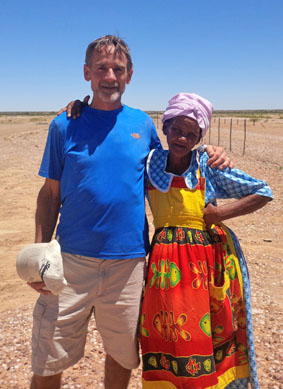
From top: Marie and Kirk on a Sunday hike; the Namibian sky; an 8th grade class in the school where Marie and Kirk teach; a dry river bed; Kirk with a Nama woman; Kirk with a school Science Club; a village home; Marie with some of the girls who live in the school hostel. (Photos provided by Marie Fitzsimmons)

Charles Haeffner
P.O. Box 365
Odessa, New York 14869